
Cause Marketing and Why We Support Organic Farming
It’s trendy to call one’s products natural and it’s trendy to support specific causes. Dubbed “Cause Marketing” this type of giving back it is supposed to influence the decisions of compassion buyers. I like to think of it as “don’t want no blood in my soap” marketing.
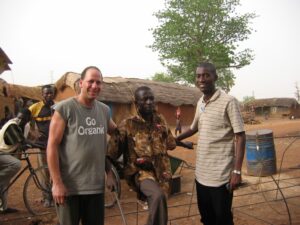
Larry Plesent in Africa
Over the past three decades Vermont Soap has tried its hand at cause marketing several times. As Founder and CEO of Vermont Soap I traveled to West Africa as a volunteer consultant for soap and shea butter entrepreneurs of all ages and educational backgrounds. I doubt it influenced a lot of people in this country to switch to our brand, but it was good for me as a person and changed the arrow of the course of my life as well as for that of the company.
When Athabasca basin shale oil gas (pretty much the most environmentally destructive energy scheme ever conceived in all human history) was pumped over a thousand miles to our little town of Middlebury, Vermont; I refused to hook our factory up to it and spoke out publicly against fracking (this is more than fracking but that was the media focus), using actual facts and hard science to back up my position. Some of our customers did not agree, and I had a long discussion with a lovely family whose only hard asset was grandma’s farm in Pennsylvania. Fracking the farm would send three of the grandchildren to college, hopefully breaking the cycle of working-class poverty they had labored under for generations.
Things are rarely as cut and dried as we might prefer them to be.
But there is one cause which we have trumpeted since the creation of the National Organic Program (NOP) in 2003. And that of course is supporting the process of Organic Farming and applying its life affirming philosophy to the creation of useful products from certified organic plant-based sources like coconut oil and shea butter.
Certified Organic means Audited Natural, from farm to bottle. It is your best opportunity to obtain genuinely safe and nontoxic food and many other products like pet shampoo. In the US we only have an organic food standard. There isn’t a separate standard for soap as an example. That means that your VT Soap products are made and certified (audited) to USDA organic food standards. Pretty radical stuff!
Here are some of the benefits or farming organically:
- Organic farming sequesters large amounts of carbon in the soil.
- It reduces the use of pesticides and herbicides in general and outright forbids the use of any that remain as residues.
- It builds soil for feeding future generations. When land is converted back to organic farming, the actual makeup of the type and percentage of microbes and fungi in the soil begins to change. Over time, as fertility returns to the soil, total output per acre gradually exceeds that of modern chemical farming techniques.
- It protects wells and watersheds from being poisoned by agricultural chemicals.
- Secondary products like foaming hand soap which are made with certified organic inputs are not allowed to use any ingredient or process that is not approved for use in producing or processing the organic food that goes in your month.
Pretty cool!
Not all certified organic products are allowed to use the USDA logo on the package. Many certified products have an organic content of between 70% and 95% and are allowed only a very small number of safe, non-organic ingredients in the formulation.
This was not part of the original plan for the NOP but was part of a compromise reached with Archer Daniels Midland (ADM) the huge agricultural products processor which paid a $100 million dollar fine for price fixing in 1996 and shows an annual profit of about $5 billion a year. They had big dollar reasons to dilute the impact and intent of the NOP as originally designed and the rest of us have had to live with it ever since.
CNN and some other news outlets have historically been critical of the organic program and the added safety of food and other products grown, processed, and formulated according to organic food standards. Given the reality of a changing climate, and the poisoning of this tiny planet we call home; we need to call out BS when it stares you in the face.
Converting our vast farmlands into properly managed organic farms is good for climate change, good for vanishing species, and good for the grandchildren. Do we really need more time to ponder which way to go?
